Augmented Reality
Augmented reality as a claim on public space: who gets to annotate buildings, borders, monuments and airspace.
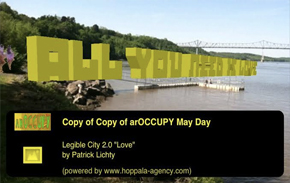
Augmented reality, in my work, is never just a visual overlay. It is a claim on public space — a question of who has the right to write on buildings, monuments, borders, galleries, landscapes and airspace when that writing is only visible through a device or a networked layer. The world is never simply the world; it is layered, annotated, contested and authored, and AR makes that condition literal.
This strand grows directly out of SPRAWL and tactical media and continues through the AR and drone-related projects, including work in the Manifest.AR context. It deals with contested geography, invisible inscription, virtual graffiti, public memory and the gamification of spatial experience. The anchor work is Augmented Reality / Contested Airspace, which treats the air above public space as a surface to be fought over.
Read together with the VR and scanning works, the AR projects complete a circuit: where VR rebuilds captured space as a world to enter, AR writes onto the space we already share.