Slow Scan TV
Imagined territories transmitted line by line as banded, lossy images: Vicapore and Duntoria.
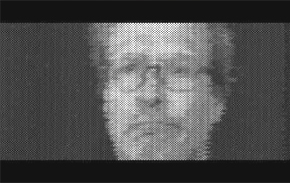
Slow Scan TV is a way of sending a still image across a narrow radio channel one line at a time. The picture does not arrive; it accumulates. Bands of colour and tone build down the frame at the speed of the link, carrying every dropout, fade and burst of noise the channel introduces on the way. I am drawn to SSTV for the same reasons I have always worked at low resolution: the image is held together by the transmission itself, and what survives the journey is the work.
These pieces treat SSTV as a method for transmitting places that may not exist. Each is built as a signal first and an image second — encoded, broadcast or played back, and recovered as a banded, time-smeared picture of an imagined territory. The slowness is not nostalgia for old equipment. It is a way of making the distance between sender and receiver visible, and of letting latency, interference and decay do part of the authoring.
Vicapore
Vicapore is transmitted as a coastal territory that only resolves under patience. The scan moves down through horizon, structure and water, and the noise floor of the channel becomes weather. Read top to bottom in real time, the work asks the viewer to wait for a place to finish arriving, and to accept the version that the signal allows.
Duntoria
Duntoria is its inland counterpart: a denser, more architectural transmission in which grids, walls and inscriptions compete with the banding of the format. Where Vicapore dissolves toward water, Duntoria accretes toward structure. Together the two function as a pair of broadcasts from neighbouring fictions, each legible only through the same slow, lossy channel.